This is a collection of PSLE Maths examples. I am thinking of starting a dedicated blog that can be useful for students.
1. Speed question
2. Speed and distance - 2 vehicles start at different times
3. Ration problem
Showing posts with label Maths. Show all posts
Showing posts with label Maths. Show all posts
Sunday, 21 February 2021

Friday, 16 December 2016
Maths - Brain Teasers

Clue - start with the number 1.
Answer is (C).
2. A bit more difficult.

Clue - use addition and multiplication
Answer is 16
3. This one is difficult.

Clue - sequential
Should the correct answer be 70 or 80 ?
4. This should be easy.

Saturday, 16 January 2016
Maths - A Faster Way To Multiply 4 Digit Numbers
This video shows a quicker way to multiply 4 digit number with another 4 digit number, like for example;
5 4 3 2
x 3 1 2 4
Another explanation of the same method
5 4 3 2
x 3 1 2 4
Another explanation of the same method
Wednesday, 13 January 2016
Maths - Multiplication Of 2 Digit and 3 Digit Numbers
A great way to multiply any pair of 2-digit and 3-digit numbers quickly and accurately. Cool !
Friday, 8 January 2016
Maths - How To Multiply Any Pair Of 2 Digit Numbers The Fast Way
This method teaches a quick way to multiply any pair of 2-digit numbers. Cool !
Wednesday, 22 July 2015
Brain Teaser - Solve This Puzzle
This problem can be solved by pre-school children in 5 to 10 minutes, by programmers in an hour and by people with higher education ..... well check it out yourself !
8809 = 6 5555 = 0
7111 = 0 8193 = 3
2172 = 0 8096 = 5
6666 = 4 1012 = 1
1111 = 0 7777 = 0
3213 = 0 9999 = 4
7662 = 2 7756 = 1
9313 = 1 6855 = 3
0000 = 4 9881 = 5
2222 = 0 5531 = 0
3333 = 0 2581 = ?
Answer
.
.
.
.
.
.
.
.
.
.
.
.
.
.
.
.
.
.
.
.
.
.
2581 = 2
The pattern counts the number of circles in each 4 digit number.
For example, 0000 = 4 and 8888 = 8
8809 = 6 5555 = 0
7111 = 0 8193 = 3
2172 = 0 8096 = 5
6666 = 4 1012 = 1
1111 = 0 7777 = 0
3213 = 0 9999 = 4
7662 = 2 7756 = 1
9313 = 1 6855 = 3
0000 = 4 9881 = 5
2222 = 0 5531 = 0
3333 = 0 2581 = ?
Answer
.
.
.
.
.
.
.
.
.
.
.
.
.
.
.
.
.
.
.
.
.
.
2581 = 2
The pattern counts the number of circles in each 4 digit number.
For example, 0000 = 4 and 8888 = 8
Wednesday, 27 May 2015
Maths - How To Multiply 2 Numbers; Japanese Multiplication Tricks.
This video shows how to multiply two numbers using a simple visual lines technique.
Friday, 17 April 2015
Maths - When Is Cheryl's Birthday ?
This is a question from the Secondary 3 Singapore and Asian Schools Math Olympiad.
See if you can solve it.

Note:
Albert knows the month.
Bernard knows the day.
The solution in videos.
See if you can solve it.
Note:
Albert knows the month.
Bernard knows the day.
The solution in videos.
Thursday, 4 December 2014
Saturday, 20 September 2014
Maths - Singapore Math
This is a collection of mathematical problems solved in a different way.
Singapore Math 1 - A Grade 5 Problem
Problem Statement
Jeremy bought 8 identical pens and 5 identical notebooks.
The cost of 8 pens is the same as the cost of 5 notebooks.
Each notebook costs 30 cents more than each pen.
How much did jeremy spend altogether ?
Watch video for solution.
Singapore Math 2 - A Grade 7 Problem
Problem Statement
Mr Rosario bought some apples and oranges.
The ratio of the number of apples to the number of oranges that he bought was 2:5.
He gave 3/4 of the apples to his sister and 34 oranges to his brother.
The ratio of the number of apples to the number of oranges is now 2:3.
How many apples did Mr Rozario buy ?
How many oranges did Mr Rozario buy ?
Watch video for solution.
Singapore Math 3 - A Grade 7 problem
Problem Statement
There are 8 more girls than boys in a particular class.
3/5 of the boys and 1/3 of the girls were born in Georgia.
If the number of boys who were born in Georgia
is the same as the number of girls who were born in Georgia,
how many students (boys and girls together) in that class were born in Georgia ?
Watch video for solution.
Singapore Math 1 - A Grade 5 Problem
Problem Statement
Jeremy bought 8 identical pens and 5 identical notebooks.
The cost of 8 pens is the same as the cost of 5 notebooks.
Each notebook costs 30 cents more than each pen.
How much did jeremy spend altogether ?
Watch video for solution.
Singapore Math 2 - A Grade 7 Problem
Problem Statement
Mr Rosario bought some apples and oranges.
The ratio of the number of apples to the number of oranges that he bought was 2:5.
He gave 3/4 of the apples to his sister and 34 oranges to his brother.
The ratio of the number of apples to the number of oranges is now 2:3.
How many apples did Mr Rozario buy ?
How many oranges did Mr Rozario buy ?
Watch video for solution.
Singapore Math 3 - A Grade 7 problem
Problem Statement
There are 8 more girls than boys in a particular class.
3/5 of the boys and 1/3 of the girls were born in Georgia.
If the number of boys who were born in Georgia
is the same as the number of girls who were born in Georgia,
how many students (boys and girls together) in that class were born in Georgia ?
Watch video for solution.
Tuesday, 16 September 2014

Monday, 9 June 2014
Maths - What Is The Parking Lot Number
This is a brain teaser. See if you can identify the parking lot number.

If you need help, scroll down.
.
.
.
.
.
.
.
.
.
.
.
.
.

If you need help, scroll down.
.
.
.
.
.
.
.
.
.
.
.
.
.
Tuesday, 13 May 2014
Maths - An Easy Way To Multiply 2 Numbers Between 11 And 19
You can easily multiply two numbers between 11 and 19 in your head using this method.
For example, you want to find what 14 x 15 equals...
Take the number 14 and the second digit of the second number, i.e. 5 and add them together.
This gives 19.
Now stick a zero at the end of that, so it becomes 190.
Remember that number.
Now take the second digit from each number, i.e. 4 and 5, and multiply them together to give 20.
Add this number to the number you calculated in the previous step, i.e. 20+190, and you get 210
For example, you want to find what 14 x 15 equals...
Take the number 14 and the second digit of the second number, i.e. 5 and add them together.
This gives 19.
Now stick a zero at the end of that, so it becomes 190.
Remember that number.
Now take the second digit from each number, i.e. 4 and 5, and multiply them together to give 20.
Add this number to the number you calculated in the previous step, i.e. 20+190, and you get 210
Tuesday, 10 December 2013
Maths - Why Do Competitiors Open Stores Next To One Another - Nash Equilibrium
Why are all the gas stations, cafes and restaurants in one crowded spot? As two competitive cousins vie for ice-cream-selling domination on one small beach, discover how game theory and the Nash Equilibrium inform these retail hotspots.
Thursday, 6 June 2013
Beauty Of Mathematics
Absolutely amazing!
Beauty of Mathematics !!!!!!!
1 x 8 + 1 = 9
12 x 8 + 2 = 98
123 x 8 + 3 = 987
1234 x 8 + 4 = 9876
12345 x 8 + 5 = 98765
123456 x 8 + 6 = 987654
1234567 x 8 + 7 = 9876543
12345678 x 8 + 8 = 98765432
123456789 x 8 + 9 = 987654321
1 x 9 + 2 = 11
12 x 9 + 3 = 111
123 x 9 + 4 = 1111
1234 x 9 + 5 = 11111
12345 x 9 + 6 = 111111
123456 x 9 + 7 = 1111111
1234567 x 9 + 8 = 11111111
12345678 x 9 + 9 = 111111111
123456789 x 9 +10= 1111111111
9 x 9 + 7 = 88
98 x 9 + 6 = 888
987 x 9 + 5 = 8888
9876 x 9 + 4 = 88888
98765 x 9 + 3 = 888888
987654 x 9 + 2 = 8888888
9876543 x 9 + 1 = 88888888
98765432 x 9 + 0 = 888888888
Brilliant, isn't it?
And look at this symmetry :
1 x 1 = 1
11 x 11 = 121
111 x 111 = 12321
1111 x 1111 = 1234321
11111 x 11111 = 123454321
111111 x 111111 = 12345654321
1111111 x 1111111 = 1234567654321
11111111 x 11111111 = 123456787654321
111111111 x 111111111 = 12345678987654321
Beauty of Mathematics !!!!!!!
1 x 8 + 1 = 9
12 x 8 + 2 = 98
123 x 8 + 3 = 987
1234 x 8 + 4 = 9876
12345 x 8 + 5 = 98765
123456 x 8 + 6 = 987654
1234567 x 8 + 7 = 9876543
12345678 x 8 + 8 = 98765432
123456789 x 8 + 9 = 987654321
1 x 9 + 2 = 11
12 x 9 + 3 = 111
123 x 9 + 4 = 1111
1234 x 9 + 5 = 11111
12345 x 9 + 6 = 111111
123456 x 9 + 7 = 1111111
1234567 x 9 + 8 = 11111111
12345678 x 9 + 9 = 111111111
123456789 x 9 +10= 1111111111
9 x 9 + 7 = 88
98 x 9 + 6 = 888
987 x 9 + 5 = 8888
9876 x 9 + 4 = 88888
98765 x 9 + 3 = 888888
987654 x 9 + 2 = 8888888
9876543 x 9 + 1 = 88888888
98765432 x 9 + 0 = 888888888
Brilliant, isn't it?
And look at this symmetry :
1 x 1 = 1
11 x 11 = 121
111 x 111 = 12321
1111 x 1111 = 1234321
11111 x 11111 = 123454321
111111 x 111111 = 12345654321
1111111 x 1111111 = 1234567654321
11111111 x 11111111 = 123456787654321
111111111 x 111111111 = 12345678987654321
Thursday, 28 March 2013
Maths - Pythagoras Theorem Explained
This is a nice video explaining the concept of Pythagoras Theorem.
Years ago, a man named Pythagoras found an amazing fact about triangles:


Years ago, a man named Pythagoras found an amazing fact about triangles:
If the triangle had a right angle (90°) ...... and you made a square on each of the three sides, then ......
the biggest square had the exact same area as the other two squares put together!
Note:
- c is the longest side of the triangle
- a and b are the other two sides
Definition
The longest side of the triangle is called the "hypotenuse", so the formal definition:
In a right angled triangle, the square of the hypotenuse is equal to the sum of the squares of the other 2 sides.
This video also explains the formula:
(a+b)²= a² + 2ab + b²
Wednesday, 20 February 2013
Maths - Which Date Is My Birthday
Charles and George are students of Mr. Smith. Mr. Smith's birthday is on D/M/1970 and both of them know that Mr. Smith's birthday is one of these dates:
4/3/1970 5/3/1970 8/3/1970
4/6/1970 7/6/1970
1/9/1970 5/9/1970
1/12/1970 2/12/1970 8/12/1970
Mr. Smith tells Charles the value of M and tells George the value of D.
Then Mr. Smith asks them "Do you know when is my birthday?"
Charles says “l don't know, but I can be sure that George does not know too.'
George says "Initially, I don't know, but I know it now."
Charles says "Oh, then I know it too.”
Based on the dialogue and the dates given, can you figure out which date is Mr. Smith's birthday?
Check the answer below:

Charles first said he does not know because all the months appear more than once. When Charles said that he's sure that George does not know either, he's hinting to George that it is not the months of the dates that have no repetition.
Charles is assuming that if George knows within being first told, it means the date has no repetitions, which are 7/6 and 2/12. Charles is saying it is not the months 6 and 12.
So you first eliminate all dates with months 6 and 12
After elimination of months 6 and 12, you're left with 4/3, 5/3, 5/9, 8/3 and 1/9.
George was able to tell which date it is by now, meaning of these dates that are left; the day number does not have repetitions. 5/3 and 5/9 eliminated.
Left with 4/3, 8/3 and 1/9. Realise of these 3 options left, it cannot be 4/3 and 8/3 because the months are the same.
Friday, 15 February 2013
The $900,000 Singapore Child
SATURDAY, 16 FEBRUARY 2013
The $900,000 Singapore child
What is the price of having a baby? A financial adviser looks at the dollars and cents of the ongoing debate about raising the fertility rate.
By Joseph Chong, Published The Straits Times, 15 Feb 2013
RECENT economic research on happiness has established a good correlation between a person's sense of well-being and his propensity to procreate. As in nature, animals need to feel well before procreation can happen.
One fundamental factor for well-being is financial sufficiency. One must earn enough to make ends meet, plus save enough for retirement and the proverbial rainy day.
Without financial sufficiency, successful procreation is unlikely because it will make you go broke. Again, nature sets the example. Animals will not procreate or will abort their offspring when resources are inadequate.
It thus makes sense, as a very basic starting point, to look at procreation as a hard-nosed business investment decision.
How financially viable is it to have children, given Singapore's cost structure and available resources? Does it cost too much for us to have our own children as a nation?
Unlike in the United States, there is little published official data on what it costs to bring up a child here. Combining my own private data with whatever published data I could find, I worked out a ballpark estimate.
As a former chief executive officer of a financial advisory firm, I have worked on and reviewed many client financial plans. From the cash-flow analysis of these financial plans, we worked out the expected costs of bringing up a child in Singapore for a mid- to upper-income family.
My estimate is about $600,000 in real dollars per child for a one-child family, and about $500,000 per child for a two-child family to raise a child. The lower figure is due to some economies of scale.
This covers the costs of raising a child, including childcare, clothing, food, schooling, imputed rental of a room to house the child. I assume tuition of $1,000 a month for 11 years, amounting to $132,000. Tuition is seen as a necessity in many families, although the amount spent varies. Household expenditure surveys suggest families spend more on private tuition than on university fees, so $1,000 a month is not unduly high. My estimate also includes the approximate costs for a four-year stint at a local university. If the child does not go to university, deduct about $100,000 from the total cost.
For this article, let's take a non-university-going, one-child family's cost of $500,000.
The implications of the $500,000 cost to bring up a child are not trivial. It means that there will be a shortfall of $500,000 in the couple's retirement fund.
Retirement has to be a top priority because it is non-negotiable - it is rarely possible to work until one passes on. An individual has a duty to himself to avoid the fate of being old and infirm but destitute.
Seen in this context, children are an option - to be exercised only if one can afford it. A retirement fund of $500,000 translates into a retirement income stream of $20,000 - using a 4 per cent draw-down rate - each year. The hard-nosed question that needs to be asked is: "Is your child worth an annual retirement income stream of $20,000?"
The above cost-estimates to raise a child do not include the estimated subsidies paid by the state. This amounts to about another $400,000, with about $300,000 going to education - assuming 13 years of subsidised education. My $300,000 estimate is higher than the government's own internal estimates because I have imputed rental. Singapore's public-funded schools do not pay rental for their premises, unlike private ones. Imputed rental cannot be ignored, as it is a substantial real economic cost.
Hence, each child is expected to cost the nation about $900,000 - $500,000 in family funds and $400,000 in state funds.
Based on about 40,000 live births each year currently, every new cohort that is born is expected to cost about $36 billion or about 11 per cent of gross domestic product or about $11,000 per Singaporean every year.
This is far more than the GDP per capita of Laos and about the same as Thailand. If the Laotians and Thais had our cost structure, they would not be able to afford any children.
The trouble with tuition
WHY is it so costly to raise a child in Singapore?
In the US, it costs about $360,000 to raise a child in a one-child US family, excluding university costs. This is about $140,000 less than the equivalent Singaporean situation.
One reason for the difference appears to be the costs of Singapore's parallel education system, which is not prevalent in the US - the expected costs of private tuition, which represents the single largest expenditure for many parents.
Based on the Household Expenditure Survey 2007/08 (HES2007) published by the Department of Statistics, Singapore resident households already spend more on private tuition for their children annually than on university fees, local and overseas combined as of 2007. Based on HES2007 and GDP breakdown data, the private tuition industry was already a $1.2 billion industry or about 17 per cent of the Ministry of Education's budget in 2007. Extrapolating to today, the private tuition industry is probably worth more than $1.6 billion annually.
The education budget increased by 78 per cent between 2005 and 2011, but parents appear to be paying increasing amounts for private tuition, which many complain is necessary because of the way their children are (not) being educated. This is akin to a company whose revenue is surging but shareholders' losses keep widening. As a professional investor, I would say that something has gone awry.
HES2007 showed that the main bulk of spending on tuition is by residents living in private properties and the largest Housing Board flats.
As a society, we need to reverse the growth of private tuition quickly. The MOE and every school should be measured on how many hours of private tuition students consume and given incentives to reduce consumption at least 10 per cent a year every year for the next 10 years. This will focus the ministry and schools to manage curriculum and teaching techniques creatively so that private tuition becomes unnecessary. Schools should also be forbidden to recommend tuition of any sort to parents. Reducing reliance on tuition will remove one great cost-barrier to fertility.
Will immigrants dilute our resources?
HOWEVER, if we decline to reduce our overall child-rearing cost structure but rely on immigration to meet the shortfall, we won't be better off because the costs are far higher than we think. Every new immigrant who is sworn in may be a tangible dilution of the wealth of all Singaporeans.
The reason rests with the balance sheet of the state, that is our reserves. Every new immigrant has a claim to benefits from the reserves. This is unlike in the US where new citizens have to shoulder the burden of federal and state debt. Part of the taxes paid by every US citizen goes into paying interest on the national debt.
The official book value of our reserves is about $308 billion. The current market value is probably about $800 billion or about $245,000 per citizen. The exact value may be moot but the benefit from the reserves is already tangible. In the 2012 budget, $7.33 billion was taken from returns on reserves - about $2,230 per citizen. If goods and services tax had been used to raise $7.33 billion, GST would have had to increase to 13 per cent - a hardship for the average citizen. Unless each new immigrant has an economic value of at least $245,000, Singapore would be diluting citizens' wealth.
When we understand the true cost of raising children in Singapore, we can see that the solution does not lie in importing immigrants. Rather, a more concerted effort needs to be made to reduce the costs of having a baby. A good start can be made from reducing the reliance on tuition.
Unfortunately, the procreation package announced by the Government on Jan 21 does not adequately address the issue of total costs of rearing a child. Instead, it shifts the cost burden from the family to the state, or other taxpayers. At $2 billion a year, it is a non-trivial recurring cost and represents about 4.3 per cent of the state budget. Although I hope it is effective, it is not possible to reasonably forecast its impact until we get a firm grip on the total cost perspective. If the total cost continues to rise aggressively, it would negate any well-intended subsidies from the state.
Until we satisfactorily address the issue of total cost, it would be imprudent to throw any more taxpayer dollars at the problem.
The writer was previously the chief executive officer of a wealth management firm.
Saturday, 9 February 2013
Arithmetic, Population And Energy - Sustainability 101
The chessboard has 64 squares. According to legend, chess was invented by Grand Vizier Sissa Ben Dahir, and given as a gift to King Shirham of India. The king was so delighted that he offered him any reward he requested, provided that it sounded reasonable. The Grand Vizier requested the following:
The king thought this a very modest request, promised it, and asked for a bag of wheat to be brought in. However the bag was emptied by the 20th square. The king asked for another bag, but then realized that the entire bag was needed for the next square. In fact, in 20 more squares, he would need as many bags as there were grains of wheat in the first bag!
The number of grains in the last square can be calculated by multiplying 2 times itself 63 times. If you include the grains on the first 63 squares, the sum is about twice as large.
The amazing feature of this problem is that with just 64 steps, each one quite modest (you are only doubling) you get a huge number. This type of rapid growth is called exponential growth.
Albert Bartlett, professor in nuclear physics from the University of Colorado, Boulder explains the concept of compound growth in this 1 hour video.
"Just one grain of wheat on the first square of a chessboard. Then put two on the second square, four on the next, then eight, and continue, doubling the number of grains on each successive square, until every square on the chessboard is reached."
The king thought this a very modest request, promised it, and asked for a bag of wheat to be brought in. However the bag was emptied by the 20th square. The king asked for another bag, but then realized that the entire bag was needed for the next square. In fact, in 20 more squares, he would need as many bags as there were grains of wheat in the first bag!
The number of grains in the last square can be calculated by multiplying 2 times itself 63 times. If you include the grains on the first 63 squares, the sum is about twice as large.
The amazing feature of this problem is that with just 64 steps, each one quite modest (you are only doubling) you get a huge number. This type of rapid growth is called exponential growth.
Albert Bartlett, professor in nuclear physics from the University of Colorado, Boulder explains the concept of compound growth in this 1 hour video.
Monday, 21 January 2013
The Prisoner's Dilemma
In Game Theory, there's a famous hypothetical scenario called the Prisoner's Dilemma in which two criminal suspects are apprehended by police.
Each prisoner is in solitary confinement with no means of speaking to or exchanging messages with the other. The police admit they don't have enough evidence to convict the pair on the principal charge. They plan to sentence both to 6 months in prison on a lesser charge. Simultaneously, the police offer each prisoner a Faustian bargain. If he testifies against his partner, he will go free while the partner will get ten years in prison on the main charge. Oh, yes, there is a catch ... If both prisoners testify against each other, both will be sentenced to five years in jail.
If both suspects stay silent, they both get off with a very light sentence. If they both turn on each other, they both get a longer sentence. And if only one of them rats out the other, the suspect who squeals goes free, while the one who stayed silent receives the worst sentence.
If both suspects stay silent, they both get off with a very light sentence. If they both turn on each other, they both get a longer sentence. And if only one of them rats out the other, the suspect who squeals goes free, while the one who stayed silent receives the worst sentence.
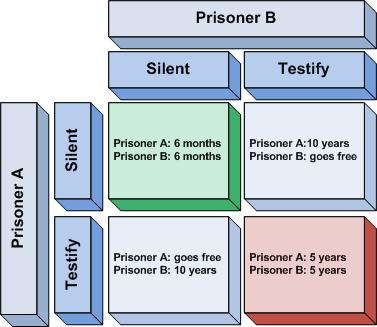
Naturally, the best choice is for both prisoners to stay silent-- they both get off with a very light sentence.
But imagine that your accomplice is in there being interrogated. You know that he's been offered the same deal... if he rats you out, he'll go free while you take the heat. When it's your turn, would you stay silent and risk a huge prison sentence while he walks?
The scenario points to an inevitable conclusion: each prisoner rats out the other, and they both do heavy jail time. It's clearly a sub-optimal outcome, known in Game Theory as the Nash Equilibrium.
But imagine that your accomplice is in there being interrogated. You know that he's been offered the same deal... if he rats you out, he'll go free while you take the heat. When it's your turn, would you stay silent and risk a huge prison sentence while he walks?
The scenario points to an inevitable conclusion: each prisoner rats out the other, and they both do heavy jail time. It's clearly a sub-optimal outcome, known in Game Theory as the Nash Equilibrium.
Subscribe to:
Posts (Atom)